
Silly Little Smackdown
Two Player Card Game
Design Lead/Producer
(Systems and UX/UI Design)

About the project and team
Genre: Collectible Card Game
Team: 3 Designers, 4 Programmers
Duration: 30 weeks
Engines: Tabletop, Custom C++, Unity 2022
Silly Little Smackdown is a two player card game designed to be a digital collectible card game. It was made as a physical game and moved into custom engine. The physical prototype was published on DriveThruRPG as a print and play game.
For the first 15 weeks the team had three programmers make the engine, then the second 15 weeks the designers and an additional programmer joined the team and started work on the game.
Design Philosophy
The design focus of this project was when the player reached the end of a playthrough they should feel like they are at a top table in a major tournament. So we designed around that feeling focusing on the power level of the game and all the ways in which a deck could be constructed.
Design Process
First Iteration
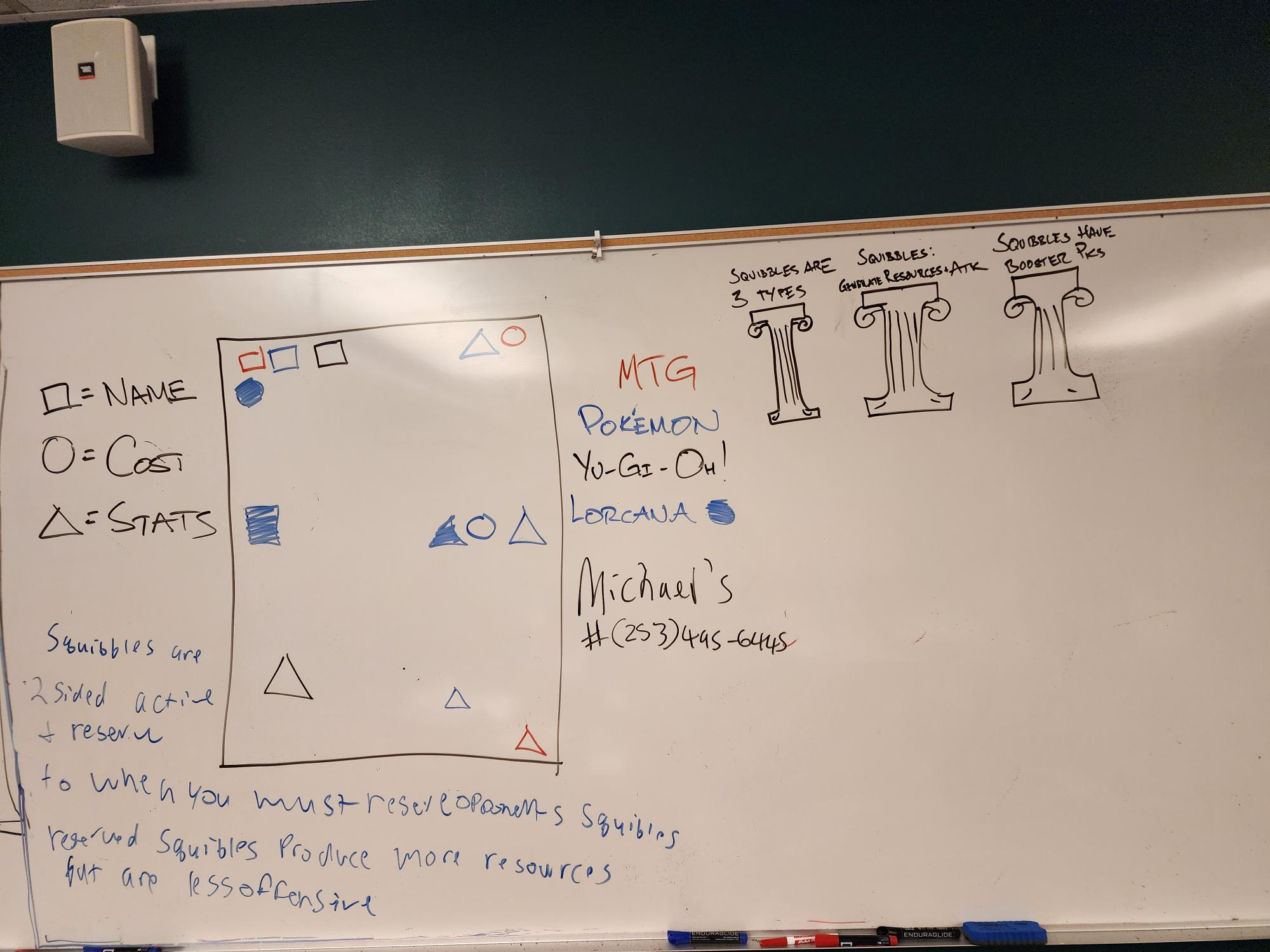
Analysis of card layouts from other games and game pillars for this project
For the first version I took printer paper and cut it into equal size pieces which I wrote by hand the bases for the offensive based deck and defensive based deck. I then playtested it and iterated based on the results
Second Iteration

To start the team got together and played a large variety of trading card games taking note of what people liked and did not like. After playing games the team worked together to come up with our design pillars.
In order to make prototyping the game easier I created a document in which you could type cards and print them out, after printing them we would put them in sleeves with other cards and we used this for prototyping.
As design lead I created a spreadsheet to keep track of all the cards I was creating and do a cost benefit analysis on so that my team members had numbers that they would be able to go off of when creating their own cards. I would play the game with anyone who would let me at any time, and after each game I would tweak the numbers to be more balanced.
When it came to implementing the game into the custom engine we were never truly able to accomplish that unfortunately as the engine never reached the point were it supported the card game the designers had created.

Retrospective

This project got great feedback on the design side, to the point we were even able to ship it. For that I am very proud of my team and I’s work on the project. However as the team’s producer and design lead I believe that there is a lot I could have done better, mostly to do with making sure the scope of the game the designers were working on was feasible for the programmers to implement. I did try and do that, consistently checking with the programmers that it was possible.